Why a HIPAA-Compliant App Builder Is More Than Just a Development Tool
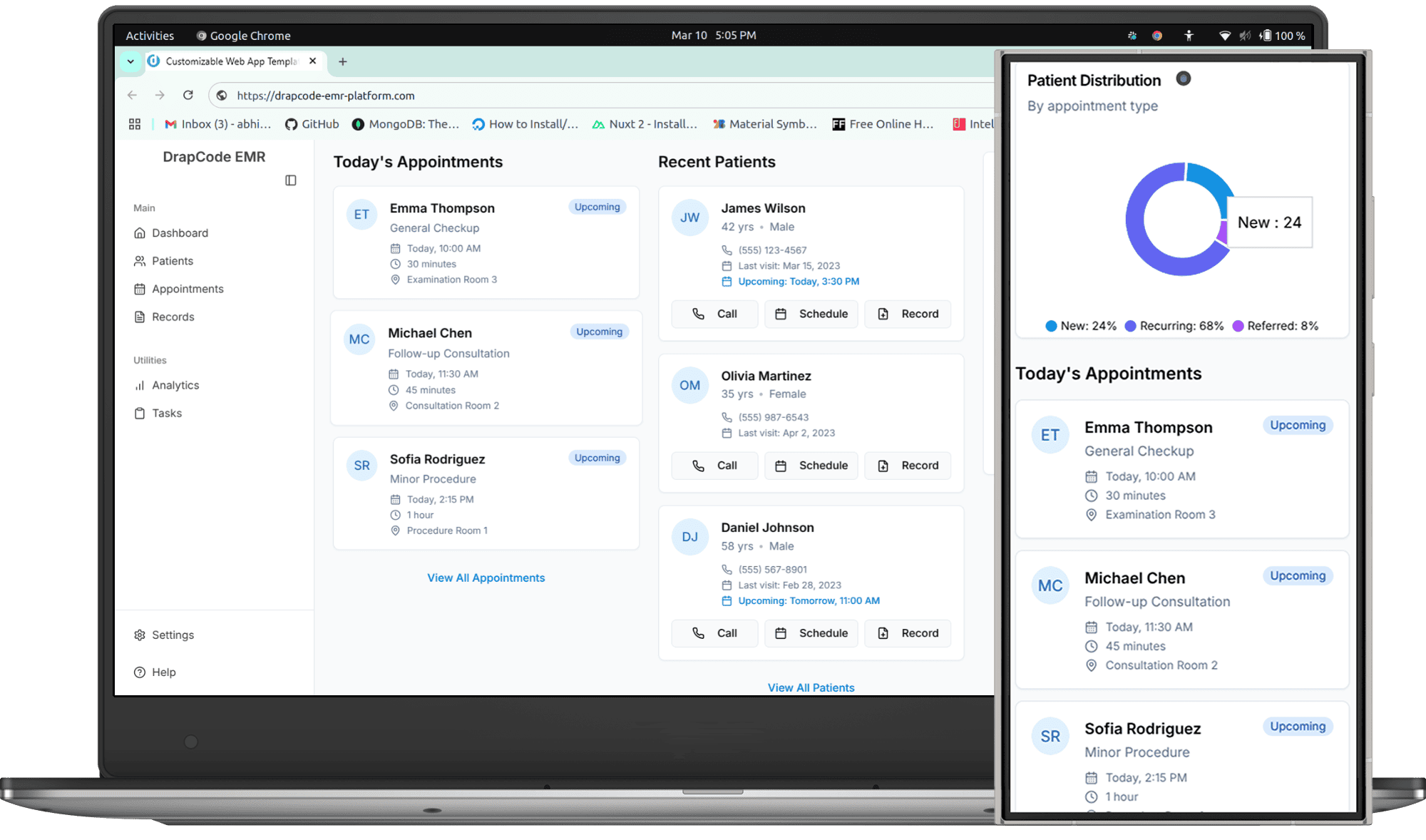
When a healthcare organization decides to build a new application, the first question is often, "How quickly can we launch?" The better question is, "Can we launch securely?"
In healthcare, speed is important, but it can never come at the expense of patient privacy. A patient portal, care management platform, provider dashboard, or EMR system isn't just another web application; it handles protected health information (PHI), integrates with clinical systems, and must support strict security and operational requirements.
That's why healthcare teams are increasingly evaluating a HIPAA-compliant app builder instead of starting every project from scratch. The right platform helps organizations accelerate development while providing the security, infrastructure, and interoperability needed for real-world healthcare applications.
Industry guidance consistently emphasizes that HIPAA readiness depends on built-in safeguards such as access controls, audit logs, encryption, and Business Associate Agreements (BAAs), not simply the ability to create an application.
Compliance Starts Before the First Feature
One of the biggest misconceptions in healthcare software is that HIPAA compliance can be added near the end of a project.
In reality, compliance influences almost every architectural decision.
Questions such as who can access patient records, how data is encrypted, where information is stored, how user activity is monitored, and how third-party services handle PHI should all be addressed before development begins.
An app builder designed for healthcare provides a stronger foundation because these considerations are part of the platform instead of being treated as afterthoughts.
What Makes an App Builder HIPAA Ready?
Not every application development platform is suitable for healthcare.
A HIPAA-focused platform should support the technical safeguards healthcare organizations expect when handling sensitive information.
Some of the most important capabilities include:
Role-based access control
Secure authentication
Audit logging
Encryption for stored and transmitted data
Secure cloud infrastructure
Backup and disaster recovery
Business Associate Agreement (BAA) support
API-based interoperability
These capabilities don't automatically make an organization HIPAA compliant, but they significantly simplify building applications that align with healthcare security requirements.
Beyond Patient Portals
When people hear "healthcare app," they often think of patient portals.
In reality, healthcare organizations build many different types of applications.
Common examples include:
Electronic Medical Record (EMR) systems
Care management platforms
Provider dashboards
Referral management applications
Appointment scheduling systems
Clinical workflow tools
Internal operations platforms
Patient engagement applications
Remote care solutions
A flexible app builder allows organizations to support these different use cases without rebuilding the underlying foundation for every project.
Interoperability Is No Longer Optional
Healthcare software rarely exists in isolation.
Applications often exchange information with EMRs, laboratory systems, billing platforms, scheduling software, and third-party healthcare services.
That's why interoperability should be one of the first evaluation criteria.
Support for healthcare APIs and standards such as FHIR allows applications to share information more effectively while reducing integration complexity as systems evolve. Modern healthcare platforms increasingly prioritize interoperability because connected systems improve both operational efficiency and care delivery.
Security Should Scale With Your Organization
Healthcare applications rarely stay the same.
A patient portal launched for one clinic today may eventually support multiple locations, thousands of users, and entirely new services.
An app builder should grow alongside those requirements.
Look for capabilities such as:
Scalable cloud infrastructure
Granular permission management
Centralized user administration
Flexible deployment options
Monitoring and audit capabilities
Planning for growth early is usually much easier than redesigning an application later.
Build Faster Without Compromising Quality
Healthcare organizations understandably want faster delivery.
Long development timelines often delay operational improvements and patient-facing services.
The goal isn't simply rapid development; it's delivering reliable software sooner.
A healthcare-focused platform reduces repetitive engineering work by providing reusable building blocks, infrastructure, authentication, security controls, and integration capabilities from the start.
That allows development teams to spend more time solving healthcare-specific problems rather than rebuilding common functionality.
Questions Worth Asking
If you're evaluating a HIPAA-compliant app builder, consider asking:
Does the provider sign a Business Associate Agreement?
How is PHI protected throughout the application?
What security controls are included by default?
Does the platform support FHIR integrations?
Can applications scale as patient volumes grow?
How are backups, monitoring, and audit logs managed?
The answers often reveal whether a platform is designed for production healthcare environments or simply adapted from a general-purpose application builder.
Final Thoughts
Healthcare software demands more than attractive interfaces and rapid deployment. It requires a secure foundation, interoperability, scalable architecture, and a development approach that recognizes the realities of handling protected health information.
A HIPAA-compliant app builder gives healthcare organizations a practical way to deliver modern digital solutions without rebuilding core infrastructure for every project. Whether you're creating a patient portal, an EMR, a care management platform, or an internal clinical application, selecting a platform designed for healthcare can reduce complexity while supporting long-term growth.
DrapCode helps healthcare providers, health systems, and digital health companies build and scale HIPAA-compliant healthcare applications on a secure platform designed for interoperability, enterprise-grade security, and rapid deployment. From patient portals and EMRs to care management systems and FHIR integrations, healthcare teams can launch production-ready software faster.